An Empty Shelf or an Expired Pastry? The Incentive Behind Fresh-Food Ordering
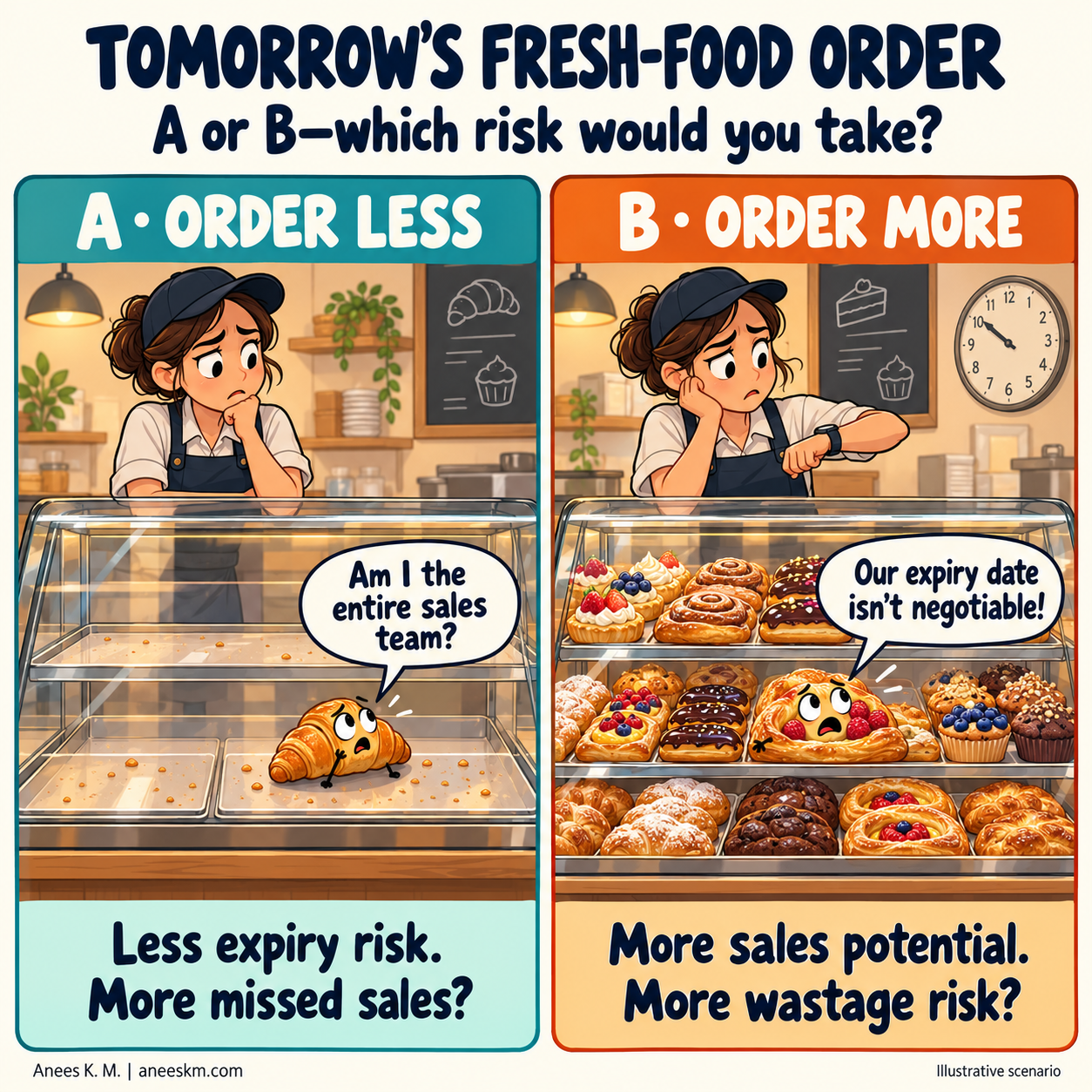
The dilemma
You place tomorrow’s fresh-food order. Demand is uncertain, and anything unsold has a limited shelf life.
A: Order less. Reduce the risk of expiry—but some customers may leave without what they wanted.
B: Order more. Give customers better availability—but risk more unsold food.
A or B—which risk would you take?
During my work with a fresh-food business in the Gulf, I encountered the real version of this dilemma.
The business wanted revenue growth. Yet the sales team was ordering cautiously, and unavailable products were costing the business sales.
The explanation became clearer when we looked at how their incentives worked.
What the incentive encouraged
More damage meant a lower incentive.
Put yourself in the salesperson’s position. Every additional tray offered an opportunity to sell. But if the products remained unsold and became damage, their incentive would fall.
The concern about expiry affected their own earnings.
Ordering less reduced that exposure. It also increased the possibility that a customer would arrive and find their preferred product unavailable.
Across discussions about ordering, availability and expiry, a conflict emerged: the business wanted sales growth, while the incentive structure encouraged caution about stock.
Instead of stopping at “Why aren’t they ordering enough?”, the more useful management question was:
“What behaviour are we making financially sensible?”
What the wastage report missed
Controlling waste is essential in fresh food. But it cannot be the only measure guiding an order.
The damaged item can be counted. The sale that never happened may leave no record.
The same extra tray can therefore look very different to the business and to the person ordering it:
| Decision or outcome | Business perspective | Ordering employee’s perspective |
|---|---|---|
| Extra tray sells | Additional sales; contribution depends on costs | An opportunity to sell |
| Extra tray expires | Wastage cost | Lower incentive under this arrangement |
| Order is reduced | Less expiry exposure, but possible missed sales | Less exposure to damage-related incentive reductions |
Illustrative comparison of the competing considerations, not a quantified assessment of the client’s results.
The lesson was not to dismiss damage or simply increase stock. Either response would overlook part of the problem.
It was to examine availability, wastage, commercial contribution and incentives together. A lower damage figure is not automatically a better business outcome if it comes at the expense of profitable sales.
Before changing the forecast
This matters when introducing AI into replenishment.
AI can help identify demand patterns and recommend order quantities. But a salesperson may hesitate to follow even a well-founded recommendation if the personal downside remains unchanged.
The forecast, the operating process and the incentive need to support the same objective.
Before changing your ordering system, ask:
- Who bears the cost of an empty shelf, and who bears the cost of an expired tray?
- Do we capture customer requests that could not be fulfilled?
- Does the incentive balance availability and damage control?
- If someone follows the system’s recommended order, how is the resulting wastage treated in their incentive?
Before asking people to change their behaviour, examine what you reward them for.
Back to the cartoon: A or B—and would your answer change if wastage reduced your incentive?
Facing a similar tension between sales, stock and incentives? Get in touch to discuss your operating model.
Related: What each sale leaves behind—a pricing lesson.
Based on an anonymised advisory experience. Identifying details have been generalised. Cartoon scenes and dialogue are illustrative; no intervention or recovery results are claimed.
Comments
Comments appear after review. Your email address will not be published. Please do not include confidential business information.