She Was Performing Well. Then Her Background Check Arrived.
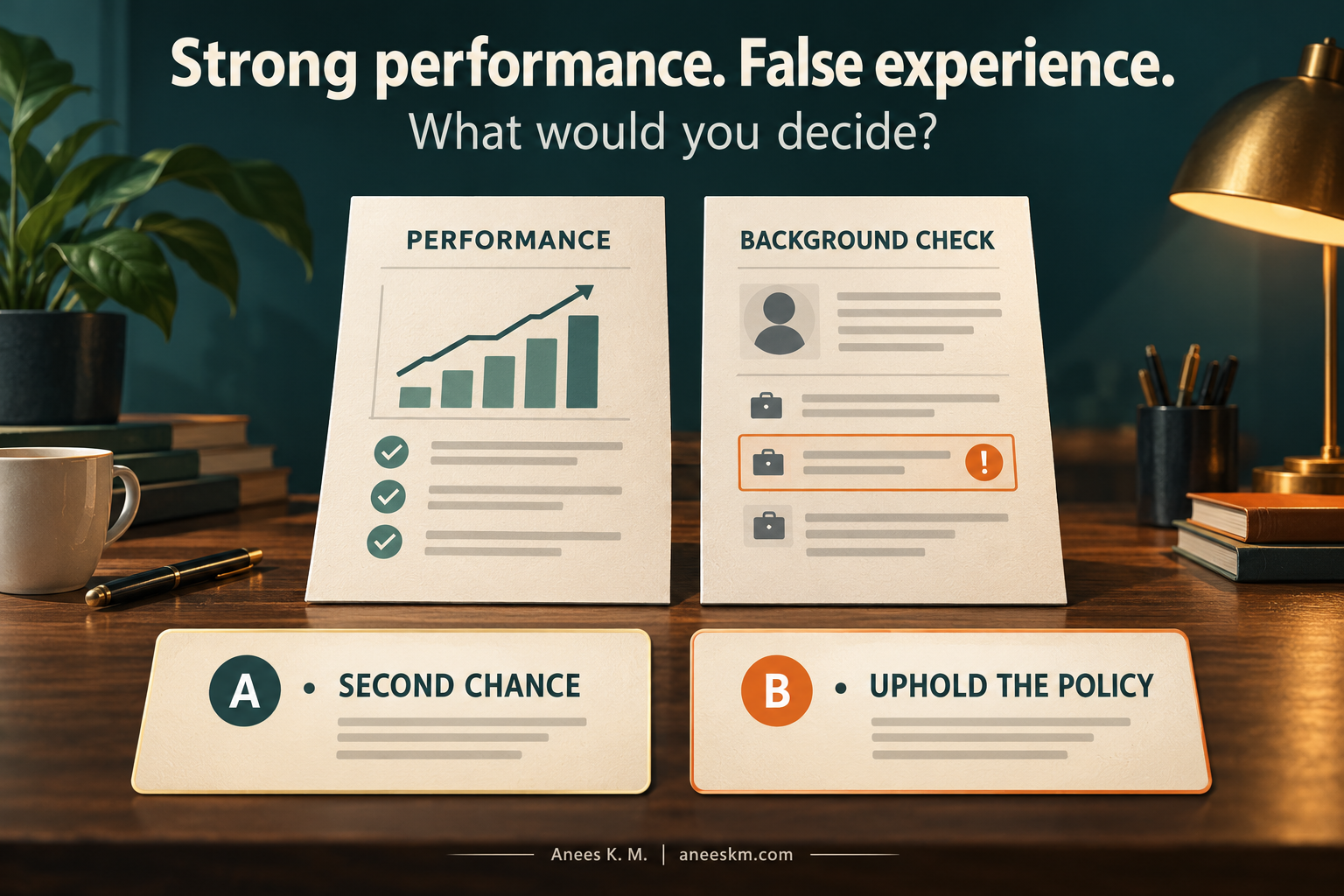
She was performing well.
Her manager wanted her to stay.
Then her background verification report arrived.
I once had to make a difficult decision about an employee whose work had quickly impressed her manager. There was every reason to be pleased with how she was settling in.
Meanwhile, her background verification was still underway.
When the report arrived, it identified a false claim about her previous work experience.
A request for a second chance
When we discussed the finding with her, she acknowledged that the claim was false.
She wanted to continue working with us. She was happy with the team and the work assigned to her. She offered to remove that experience from her record and accept a lower salary.
Her manager supported retaining her.
That made the situation difficult. This was someone doing good work, with a manager who wanted to give her another chance.
Her proposal also gave us something concrete to consider: correct the record, revise the salary and allow her to continue.
But would those changes address the reason the decision had become necessary?
What the offer could—and could not—change
Removing the experience would correct her record. Reducing her salary would change the terms of employment.
Neither could undo the false information provided during hiring.
For this organisation, trust was a firm policy boundary. Good performance did not remove the requirement to uphold it.
I understood what this job meant to her and why her manager wanted her to stay. But I also had a responsibility to uphold the company’s trust policy.
I discussed the situation with the CEO. With both the employee and her manager asking to continue, it was a significant decision that deserved careful consideration.
The decision remained clear: we had to let her go.
Clear does not mean easy
It would be misleading to describe this as a moment when I was unsure whether trust mattered. I was clear about the policy and my responsibility to follow it.
The difficulty was accepting the human consequence.
The employee wanted to stay. Her manager valued her work. Upholding the policy meant disappointing both of them and losing someone who was performing well.
Leadership sometimes means making a decision that your head understands clearly, but your heart finds difficult.
I do not tell this story to suggest that every discrepancy in a background report deserves the same response. In this instance, the employee acknowledged the false claim, and the organisation’s trust policy determined our decision.
That distinction matters. A decision should rest on what has been established and the policy that applies—not simply on the appearance of a warning in a report.
What this experience taught me
A commitment to integrity is easy to state when it costs nothing.
The harder test comes when the person involved is someone the team wants to retain.
This experience made the cost of that commitment tangible for me. We could recognise her contribution, understand her request and still conclude that we could not continue the employment.
It also left me with questions that leadership teams should discuss before facing a similar situation:
- Are our expectations about truthful information clear during hiring?
- Have we understood the finding and heard the employee’s explanation?
- Would we apply the same standard if this person’s performance were less impressive?
- Who is accountable for the decision, and how will it be communicated respectfully?
These questions do not remove the discomfort. They help keep the decision grounded when personal feelings and business needs pull in different directions.
What would you decide?
Imagine you are responsible for the decision. The employee is performing well, acknowledges the false experience claim and asks for another chance. Her manager supports her.
A. Give her a second chance with a formal warning.
B. End the employment because the false claim breached the company’s trust policy.
What would guide your choice—and would your answer change if she were your strongest performer?
Based on my own experience. Identifying details have been withheld to protect the employee and organisation. The illustration is conceptual.