Buying at ₹100, Selling at ₹90—and Becoming a Millionaire?
By Anees K. M. | 12 October 2026 · Updated 16 October 2026
New: what India’s wholesale inflation reading means for this pricing lesson →

He bought each item for ₹100 and sold it for ₹90. Transport and handling cost him extra. Business was brisk. And he became a millionaire.
How?
I was fortunate to work closely with Musthafa for nearly six years at iD Fresh Food. I joined as the first CXO after him, and we subsequently brought in the other CXOs as the leadership team grew. One story he shared with me has stayed with me ever since.
The answer to the puzzle? He started as a billionaire.
The joke makes us smile. The serious question is what each sale actually leaves behind.
Your costs explain why you want a higher price. Customer value influences whether buyers will accept it.
A price increase, a change in product mix and an improvement in delivery economics address different problems. Before choosing one, understand where the pressure comes from.
What a ₹100 sale can actually leave behind
Consider this simplified example, separate from the cartoon. These are illustrative figures, not client results; all amounts exclude tax.
| Per ₹100 of gross sales | Base case | Under pressure |
|---|---|---|
| Discounts | −₹5 | −₹5 |
| Product cost, incl. packaging | −₹65 | −₹65 |
| Freight | −₹8 | −₹12 |
| Expected unrecovered cost of returns | −₹4 | −₹8 |
| Contribution before fixed overheads | ₹18 | ₹10 |
The returns allowance is a separate expected cost and has not already been deducted elsewhere in this example.
Sales stay at ₹100, but the amount left to cover fixed overheads falls by about 44%. Higher freight and returns reduce contribution from ₹18 to ₹10, before any change in sales.
Four questions before changing the price list
1. What does serving this sale really cost?
Look beyond ingredients or purchase price. Include packaging, processing, channel discounts, transport, returns and collection costs. Keep product contribution distinct from overall profitability after overheads. Revenue alone answers neither question.
2. Where do the averages hide a problem?
A profitable product can be costly to serve on a particular route or through a particular arrangement. Examine product, customer and route economics where reliable data permits. A company-wide average may conceal an issue requiring a targeted response.
3. How might customers respond?
Will they buy less often, choose a smaller pack or switch brands? Listen to retailers and customers. Where practical, test a change and assess repeat buying and contribution together, rather than celebrating the first higher invoice.
4. When does the cash arrive?
Profit and cash flow are different. Growth can require additional inventory and credit before money returns to the bank. Check whether the business can fund the proposed growth as well as earn from it.
These four questions also give AI a practical job. With dependable sales, cost and collection data, AI and analytics can help flag costly product–route combinations, weakening repeat orders and emerging cash-flow risks. I start with the commercial question, then use the tools to help answer it. Finance, sales and operations must validate the signals and decide what to change.
Temporary losses can be deliberate—for example, a defined introductory offer. They need a clear purpose, funding limits and a credible route to profitability. The danger is failing to recognise losses because the sales report looks encouraging.
Update: 16 October 2026 — same sales, less left behind
India’s September wholesale inflation reading makes this pricing lesson timely again. The official release dated 14 October puts provisional WPI inflation at 11.39% year on year, compared with 9.92% in August. This is an economy-wide indicator, not a measure of any individual company’s cost increase.
For an FMCG founder, the useful question is: if sales stay the same, what happens to the amount left after serving those sales?
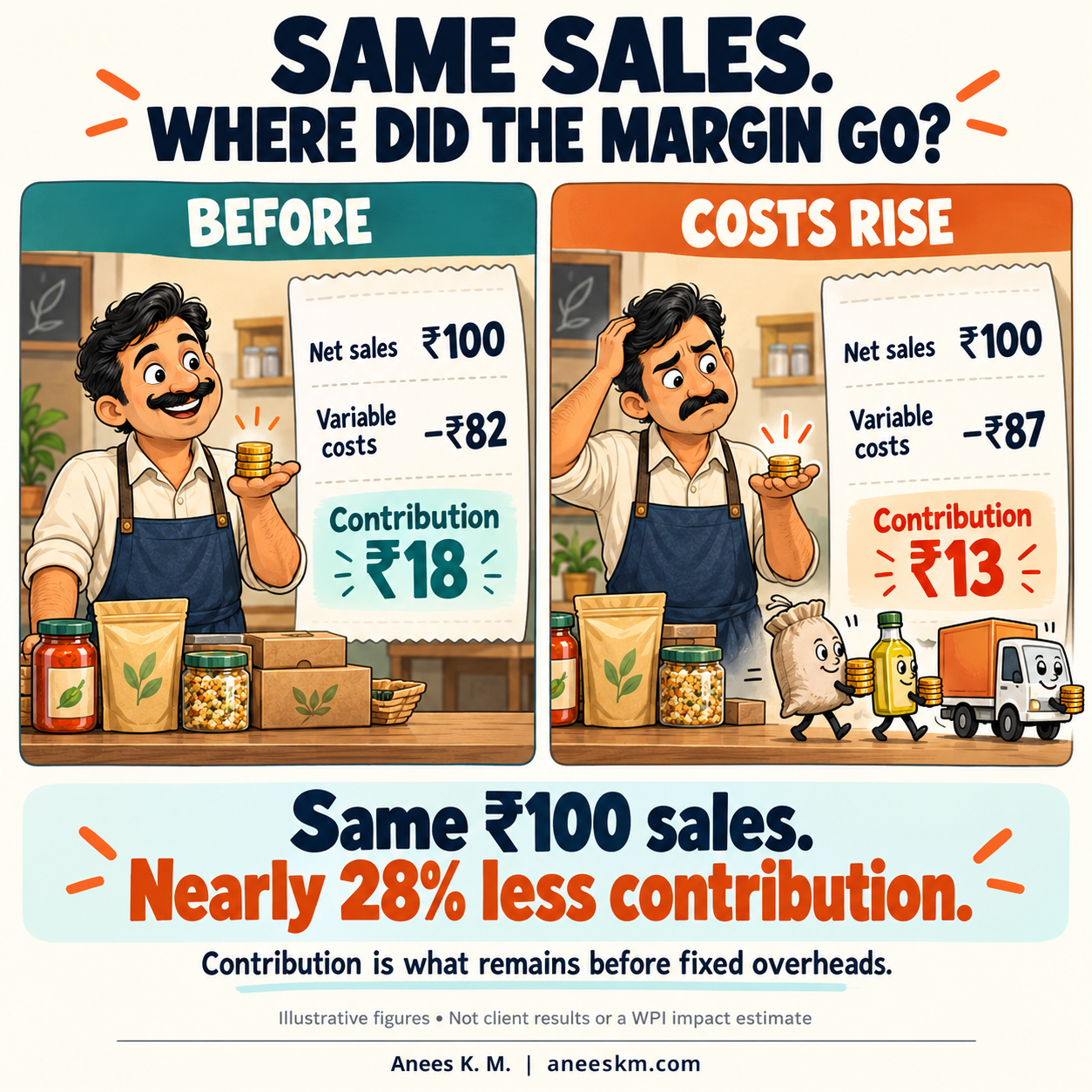
In this separate illustrative scenario, net sales after discounts remain ₹100. Variable costs rise from ₹82 to ₹87. Contribution before fixed overheads falls from ₹18 to ₹13: a ₹5 cost increase cuts contribution by about 28%.
Illustrative figures only, excluding tax; not client results or an estimate of the effect of WPI inflation. This example uses net sales after discounts, unlike the gross-sales breakdown above. WPI and retail inflation use different baskets; their gap cannot be read directly as a company’s margin loss.
What I would check before raising prices
- Product and route contribution: recalculate using current input, packaging, freight and returns costs. Find where the change is concentrated.
- Discounts and service commitments: check whether rebates, small deliveries or frequent replenishment are consuming the contribution the price list appears to promise.
- Supplier contracts: identify fixed prices, renewal dates and index-linked terms. Where adjustments apply, check whether they can move down as well as up.
- Customer response: compare a targeted price change with changes to pack, mix or delivery frequency, then track volume and contribution together.
AI can help compare current costs with product–route sales and flag where contribution is deteriorating. The value comes from connecting reliable data to a decision; finance and operations still need to validate the signal.
The sales report can look steady while the economics underneath it change. Review what each sale leaves behind before deciding what to change.
The original news connection
AP’s 8 October report on PepsiCo’s planned US price increases and cost cuts brought this lesson back to me. It is a timely reminder to examine pricing, customer value and cost to serve together.
Thank you, Musthafa, for a lesson that has stayed with me: understand the economics before celebrating the activity.
When margins tighten in your business, what do you look at first: price, product mix, or cost-to-serve? Let me know below.

The cartoon is an illustrative anecdote, not a description of iD Fresh Food or PepsiCo’s actual margins. The recollection is paraphrased, not a verbatim quotation.
Want to understand what your product and route mix actually contributes? Get in touch to discuss a contribution review of your business.
Comments
Comments appear after review. Your email address will not be published. Please do not include confidential business information.